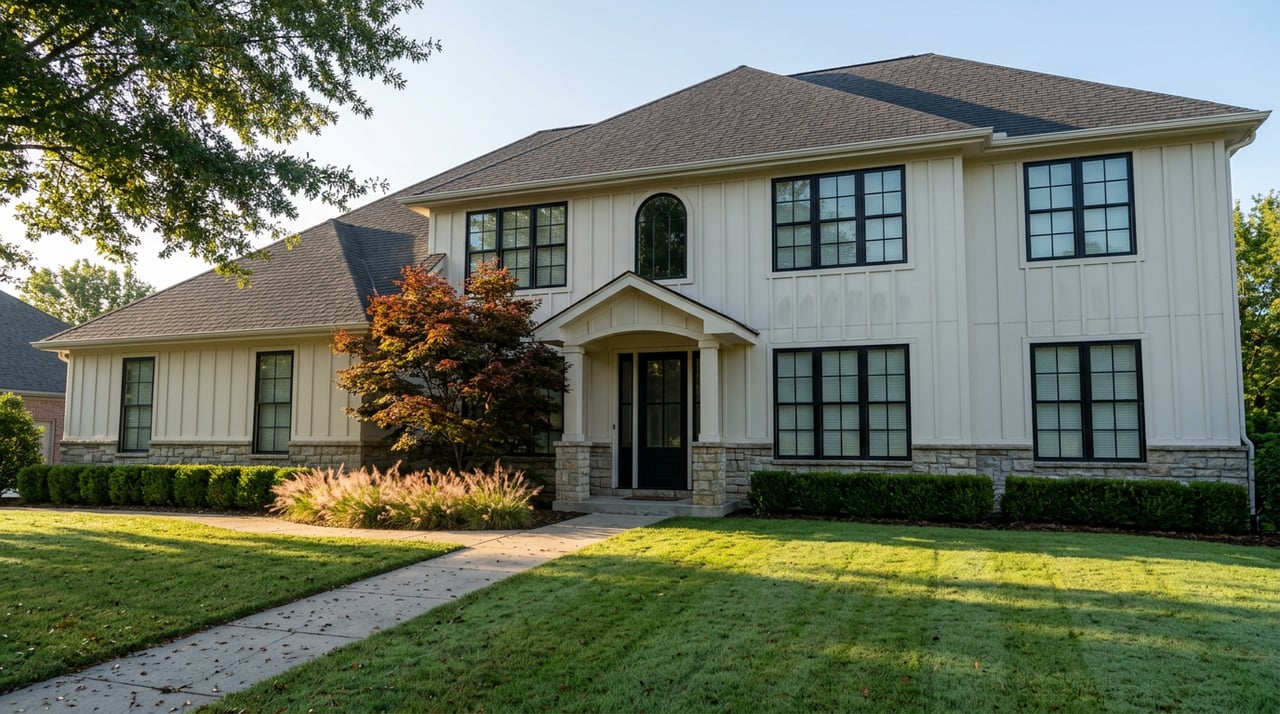
Search "Pineville home prices" tonight and you will find three sites confidently disagreeing with each other. One says the market cooled. Another says it spiked eighteen percent. A third splits the difference. All three are pulling from real closings and real listings in the same small town, in roughly the same stretch of 2026. None of them are wrong. They are just measuring a market too thin to hold still long enough to photograph.
That is the actual story in Pineville this fall, and it matters more to a buyer or seller here than any single number does. If you are comparing Pineville to Ballantyne, Fort Mill, or another Charlotte-area suburb using whatever median price loads first, you are comparing noise to noise. The fix is not to find the "right" website. It is to understand why a town this size can't produce a trustworthy single median in the first place, and what to look at instead.
Three Snapshots, Same Town, Same Season
Redfin's Pineville data, covering the three months ending May 2026, put the median sale price at $433,000, down 3.2 percent from the same stretch a year earlier. On the same page, median price per square foot ran the other direction entirely: $228, up 6.5 percent year over year. Homes were also selling a touch faster, averaging 39 days on market against 42 the year before, even as the raw count of closings slipped from 39 to 34.
Movoto's August 2026 read on Pineville told a different story: a median list price of $522,000, up 18 percent year over year, with days on market climbing to 62.
Those two numbers are not even measuring the same thing. One is a sale price on closed transactions. The other is an asking price on active listings. A seller can list high and still close low, and in a town where the buyer pool is small, a handful of ambitiously priced listings sitting on the market can drag the "for sale" median up while the "sold" median drifts down. Neither figure is fabricated. They are answering different questions and getting treated online as if they answer the same one.
| Source | Metric | Value | Window | Change |
|---|---|---|---|---|
| Redfin | Median sale price | $433,000 | 3 mo. ending May 2026 | down 3.2% YoY |
| Redfin | Median price/sq ft | $228 | 3 mo. ending May 2026 | up 6.5% YoY |
| Movoto | Median list price | $522,000 | August 2026 | up 18% YoY |
Why Thirty Sales Can't Hold A Trend
Pineville is a small town, and small towns produce small sample sizes. Redfin counted 34 home sales in May 2026, down from 39 the year before. Go back further and it gets thinner still: a Rocket Homes report on January 2025 recorded only six homes sold in the entire town that month, two thirds of them closing within thirty days.
Six sales. That is not a market trend. That is six households making six unrelated decisions, and whichever six homes happen to close in a given month decide the headline number for the whole town. If three of those six are updated ranch homes near downtown and three are freshly built single-family homes on the edge of a new subdivision, the median will land somewhere in the middle and tell you almost nothing about what either group of buyers actually paid for what they got.
This is the mechanical reason Pineville's median swings so hard from one snapshot to the next. It is not that values are unstable. It is that the sample size is small enough for the mix of what happened to sell to matter more than what buyers were actually willing to pay for comparable homes.
The Three Pinevilles Inside One Median
The reason the mix shifts so much from month to month is that "a home in Pineville" can mean three genuinely different products.
The historic core sits along Main Street in the Pineville Commercial Historic District, where landmarks like the old Yandell Hotel and Grocery Building and the former Pineville Post Office, now home to McCoy's Barbershop, anchor a walkable downtown. A few blocks over, the Park Avenue neighborhood is lined with early 20th-century mill houses set along a tree-shaded median, small-footprint homes built for textile workers a century ago and gradually updated ever since.
Then there is the established suburban layer built up through the 1990s and 2000s: neighborhoods like Danby, where a recent listing showed a 1,119-square-foot single-story home on close to a quarter acre with no HOA at all, and Cardinal Woods, a newer community with sidewalks and street lighting near the Four Mile Creek Greenway and the Ballantyne Bowl. These are the homes with room to negotiate on price because there is no builder incentive structure setting the floor.
And then there is what is actively being built right now. DRB Homes is marketing Miller Farm, a new luxury single-family community about two miles from downtown Pineville with a pool, cabana, and resort-style amenities. Stanley Martin is building Coventry, a townhome community inside Pineville starting in the low $400s, each unit including a lower-level recreation room built for the way people actually use flex space today.
A hundred-year-old mill house, a no-HOA 1990s ranch on a quarter acre, and a brand-new $400,000-plus townhome with a builder warranty are not competing for the same buyer, and they should not be judged against the same median. When one month's closings lean toward the historic core and the next month's lean toward Coventry, the town-wide number moves even though nothing about actual home values changed underneath it.
A median price only means something when the homes behind it are similar enough to average together. In a town this small, they rarely are.
What This Means If You're Pricing A Move
If you're watching Pineville because you're comparing it to other Charlotte-area suburbs, or because you already own here and want to know what your equity actually looks like, the headline median is the wrong tool. A few things are more useful:
- Match the metric to the question. A sale-price median tells you what buyers actually paid. A list-price median tells you what sellers are hoping for. Don't average across the two.
- Ask for comps inside your tier, not the town average. A Park Avenue mill house and a Coventry townhome are not comparable properties even if they close in the same calendar month.
- Watch price per square foot within a subdivision over several months rather than one town-wide median over one quarter. It filters out some of the mix-shift noise that a raw median cannot.
- Expect the numbers to look different depending on the day you check. With roughly three to four dozen sales a month townwide, a single unusual closing can move the median more than it would in a market with hundreds of monthly sales.
None of this means Pineville is a risky or unpredictable place to buy or sell. It means the town's real estate market simply doesn't generate enough monthly volume for a single aggregate number to carry the weight most portals put on it. The individual neighborhoods inside Pineville, from the historic downtown blocks to the new communities going up near Sugar Creek, each have their own more stable story. That story just doesn't show up in a townwide median.
Frequently Asked Questions
Is Pineville currently a buyer's market or a seller's market? The data doesn't point cleanly to either. Falling median sale price alongside rising price per square foot and faster time on market is a pattern more consistent with a thin, mixed market than with a clear shift toward buyers or sellers townwide. The honest answer depends heavily on which of Pineville's three housing tiers you're actually shopping in.
Why do different sites show different days on market for Pineville? Because they're often measuring different pools of listings and different windows. Redfin's figures reflect closed sales over a rolling three-month period. Movoto's reflects active listings at a single point in time. Both can be accurate and still tell different stories about the same month.
Does a falling median price mean Pineville homes are losing value? Not necessarily. With such a small number of monthly closings, a shift in which types of homes happened to sell can move the median without any individual home losing value. Price per square foot within a specific subdivision is a steadier gauge than the townwide median for that reason.
If you're trying to make sense of what a specific Pineville property, or a specific subdivision, is actually worth right now, that's a conversation better had with real comps than with a headline number. Aralena Paulette works this market closely enough to know which tier a given address falls into and what that means for pricing it accurately. Schedule a Consultation to get a read on your specific street, not just your town.